Genotopia
Genotopia is a full-stack DNA analysis platform built with Next.js, TypeScript, and MongoDB. Users upload their raw DNA file from MyHeritage, and AI research agents powered by Claude analyze each SNP against academic sources like SNPedia and ClinVar. The dashboard presents categorized health findings with confidence ratings, risk levels, and exportable PDF reports.
01 — Overview
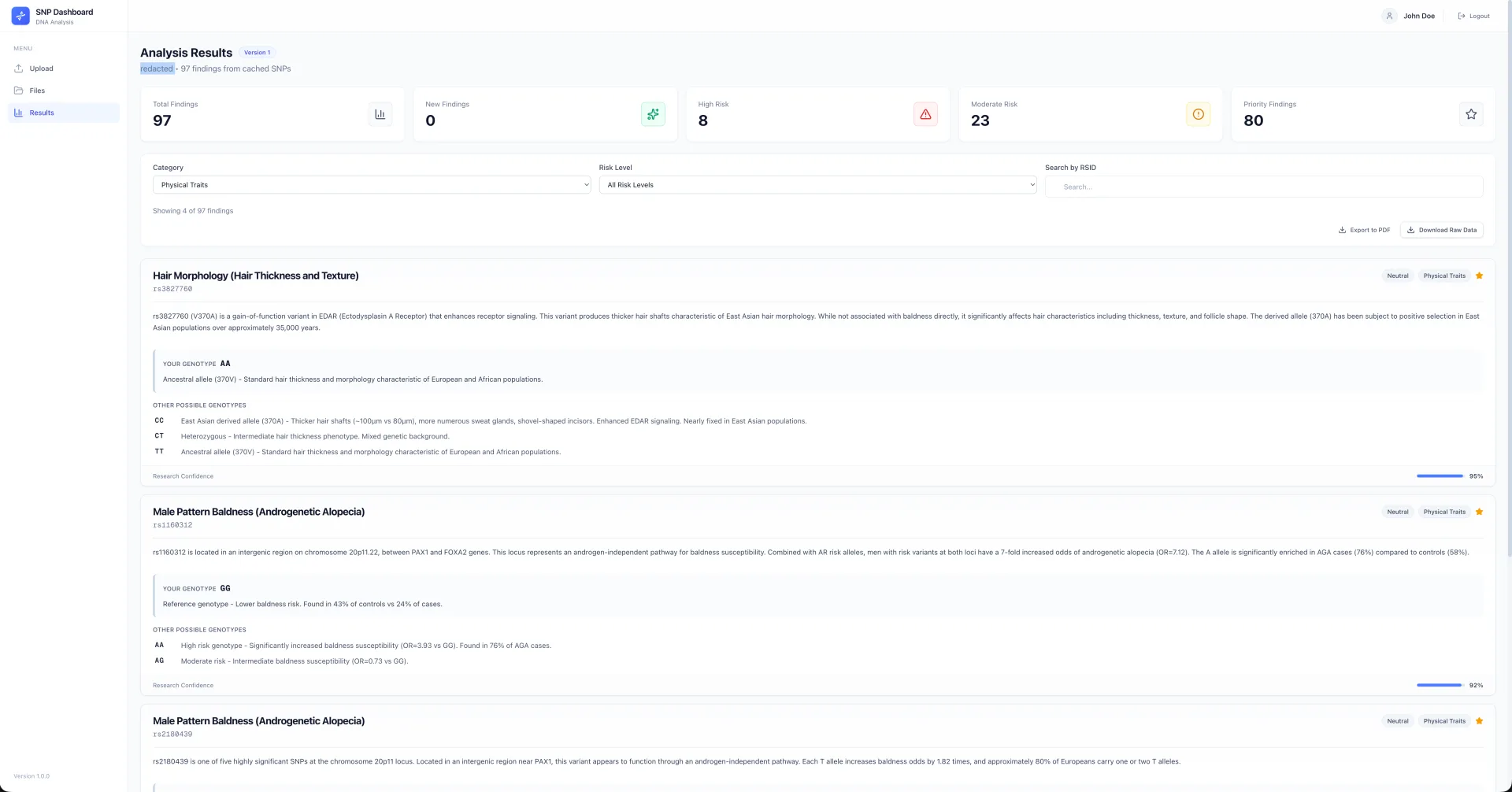
Genotopia takes raw DNA data exported from MyHeritage and transforms it into a medical insights dashboard. After uploading a CSV file containing thousands of SNPs, parallel AI research agents analyze each one against databases like SNPedia, ClinVar, and dbSNP. Results are categorized into areas such as cardiovascular health, cancer risk, pharmacogenomics, neurological traits, metabolism, nutrition, fitness, and ancestry. Each finding includes a confidence rating and risk level indicator, and the entire report can be exported as a PDF. The platform supports multiple users and DNA files, with a global SNP cache that speeds up analysis for shared genetic variants.
02 — Motivation
It started with a DNA test through MyHeritage, which only revealed my ethnic background. I discovered that MyHeritage lets you download the raw sections of your DNA that were analyzed — a CSV file containing your SNPs. I realized these SNPs could also reveal medical information about my health background, but getting that analysis meant paying yet another third-party service. So I thought: why not build my own analysis platform? That way I could share it with family and friends who also tested with MyHeritage, without anyone having to pay for a separate medical analysis. The dashboard is actively maintained in private mode and is also actively used by my uncle, who is a medical doctor, to review the findings.
03 — How it works
When a DNA file is uploaded, it is parsed with PapaParse and stored locally. The analysis runs in two phases: first, clinically significant SNPs are prioritized, then the remaining variants are processed in the background. Five concurrent Claude AI research agents query academic sources for each SNP, assess its medical relevance, assign a confidence rate, and categorize the finding. Results are cached globally in MongoDB so subsequent uploads benefit from previous research. Real-time progress is streamed to the UI via Server-Sent Events, and the final dashboard presents findings in a clinical-style interface with filtering, risk level indicators, and summary statistics.